Rules
Alberta PIPA and energy-sector worker data in Calgary and Edmonton
Alberta PIPA worker data rules cover monitoring, drug-test records and contractor files in Calgary and Edmonton, plus complaints to the Alberta privacy commissioner.
What to take away
- Alberta PIPA worker data sits with the employer: the company decides why it collects, how long it keeps and who sees it.
- Section 7 of PIPA limits collection, use and disclosure to purposes that are reasonable in the circumstances, and section 8 makes consent the rule.
- PIPA lets an employer handle 'personal employee information' without consent when it is reasonably needed to manage or end an employment relationship.
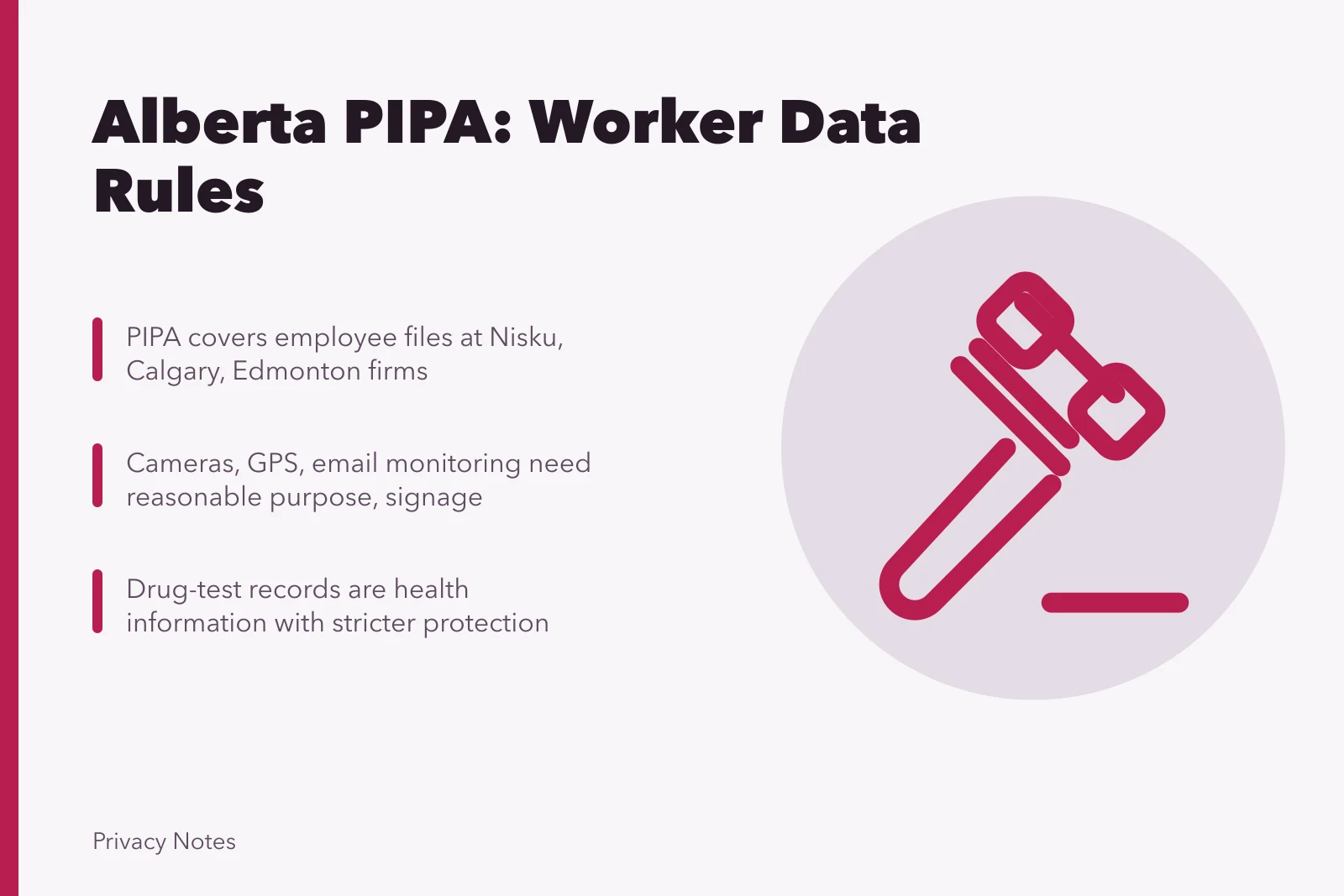
- Cameras, GPS, email filtering and electronic logging devices are allowed only where the purpose is reasonable and workers are told.
- Drug-test records are health information, so Alberta's Personal Information Protection Act (PIPA) treats them more strictly than timesheets or site logs.
- Contractors and vendors in the energy sector often carry privacy duties under their own contracts and under PIPA when they handle worker files.
- The Office of the Privacy Commissioner of Alberta takes complaints, investigates and can order an organization to change its practices.
- An access request must be answered within 45 days, and a breach that creates a real risk of significant harm must be reported to the commissioner and to affected workers.
- Small Calgary and Edmonton employers can cut most risk with a written purpose, a retention limit and a working access request process.
How Alberta PIPA applies to private-sector employers
Alberta's Personal Information Protection Act (PIPA) governs how private-sector organizations in the province collect, use and disclose personal information. It applies to a drilling contractor in Nisku, a fabrication shop in southeast Calgary and a pipeline maintenance firm in Edmonton. If your business holds an employee file, PIPA covers it.
PIPA is provincial law, not federal. The Office of the Privacy Commissioner of Canada publishes guidance on employers and employees that explains where federal rules sit.
Its overview of privacy laws in Canada sets out how provincial and federal statutes divide the field. In Alberta, provincially regulated employers work under PIPA rather than the federal Personal Information Protection and Electronic Documents Act.
Three duties shape almost every workplace decision. Collect only what a reasonable person would consider appropriate in the circumstances. Tell the worker what you are collecting and why, either before or at the time of collection. Give the worker access to their own information and a route to correct errors.
The Act numbers these duties, and employers should know them. Section 7 of PIPA says an organization may collect, use or disclose personal information only for purposes that are reasonable in the circumstances and only to the extent that is reasonable for those purposes. Section 8 makes consent the rule.
There is one large exemption behind those words. PIPA lets an employer collect, use and disclose 'personal employee information' — the information it reasonably requires to establish, manage or end an employment relationship — without consent, provided the handling is reasonable for that purpose.
Every organization must also designate one or more people to be responsible for compliance with PIPA. PIPA gives an organization 45 days to respond to a worker who asks to see the information held about them.
Consent is the default, but PIPA allows collection without consent in narrow cases, such as when a file is needed to investigate a breach or to collect a debt. Employers who lean on those exceptions should document the reasoning at the time, not months later.
The Canadian Centre for Occupational Health and Safety maintains a legislation hub and a companion page on acts and regulations that help employers locate the statutes behind occupational health and privacy duties. Use them to check which law applies before you draft a policy.
A short personal data privacy guide is a useful starting point for mapping collection, use, sharing, retention, security and deletion across a payroll or safety system.
Employee monitoring: cameras, GPS, email and electronic logging devices
Employee monitoring Alberta employers run falls into four common buckets: yard and shop cameras, vehicle GPS, email and network monitoring, and hours-of-service tracking. Each needs a purpose that survives scrutiny.
Alberta's Occupational Health and Safety Act is often the reason a site monitors workers at all. It requires employers to assess hazards and protect worker health and safety, and that duty has to be carried out in a way that collects the least personal information needed.

Cameras in a lunchroom or change area rarely do. Cameras covering a gate, a fuel bay or a parts cage usually do, because the purpose is loss prevention or safety. Post signage that says who is recording, what is captured and who to contact. Covert monitoring is hard to justify and should be a last resort with legal advice.
GPS in company trucks and pickups is common across the energy sector. Tracking during work hours for dispatch, safety or billing is one thing. Tracking a worker's personal time in a company vehicle, or using location history to build a performance file without telling anyone, is another. Set the device to record what the stated purpose needs.
Email and network monitoring should rest on a written acceptable-use policy that workers have seen. Reading a union representative's private messages, or a worker's personal webmail, goes well beyond ordinary system administration.
Electronic logging devices raise a specific set of questions. Transport Canada describes how electronic logging devices work and what they record for federally regulated commercial drivers. Those records are personal information about a named driver, so PIPA duties apply alongside the federal motor carrier rules.
A simple test before you switch anything on: can you write the purpose in one sentence, and would the worker accept it if you read that sentence aloud? If not, the monitoring is probably overreach.
Work through the personal data lifecycle checklist before adding a new camera, tracker or logging system to a site.
Drug-test records and the limits on collecting health information
Drug-test records are health information. Under PIPA that matters, because health information attracts a higher level of protection than routine employment data, and because a positive result can follow a worker for years.
Employers in Calgary and Edmonton usually collect drug-test data for one of three reasons: pre-access requirements at a site, post-incident testing, or reasonable cause. Each has a different privacy profile. Pre-access testing on a large industrial project may be a condition of site entry, which does not remove the employer's duty to limit what it keeps.
Privacy is only half of the drug-test analysis. The Alberta Human Rights Act governs the other half. A positive test can amount to discrimination on the basis of disability or perceived disability, so an employer has to justify testing as a bona fide occupational requirement — tied to a genuine safety risk, applied consistently, and no broader than the risk requires.
The record itself should be narrow. A pass or fail, the date, the testing provider and the substance screened is usually enough for an access decision. The full laboratory file, medication lists and medical history belong with the testing provider, not in the site office.
Retention is where many small employers slip. A negative result rarely needs to be kept beyond the access decision. A positive result may need to be held longer for safety or human rights reasons, but the file should say why and for how long.
Disclosure is the other trap. Sending a full result to a prime contractor, a client or a staffing agency can breach PIPA unless the worker consented or the disclosure fits an exception. Share a clearance status, not a medical file.
Treat test results as a distinct category. Comparing personal data categories helps a safety manager separate a clearance flag from sensitive health detail.
Contractor and vendor data in the energy sector
Contractor data in the energy sector moves in several directions at once. A prime contractor collects worker files from subcontractors. A staffing agency holds tickets, certifications and medical clearances. A vendor running a timekeeping or learning platform holds records for hundreds of workers it never employs.
PIPA follows the information. If your Edmonton firm holds a contractor's personal information for its own purposes, such as site access or payment, you have duties for that information. A service provider acting only on your instructions has a different role, but you still need a written agreement that limits what it can do with the data.
Turnover is the practical problem. Energy projects ramp up and wind down, and worker files can sit in shared drives long after the site closes. Build a close-out step into every project: return or destroy contractor records, keep only what a contract or law requires, and record who signed off.
Subcontractor chains are the weakest link. A small electrical contractor may pass a worker's ticket and clearance data to three parties in a week. Each handoff needs a purpose, and the worker should be able to find out who holds what.
Vendor contracts should name the data, the permitted uses, the retention period, the security standard and the breach notification timeline. Vague clauses about "administering the relationship" invite personal data lifecycle problems later, when nobody can say why a file still exists.
PIPA's breach rules are why those clauses matter. When a breach of security safeguards creates a real risk of significant harm to a worker, the organization must notify the Office of the Privacy Commissioner of Alberta and the affected individuals without unreasonable delay, and explain what happened and what it is doing about it.
The Office of the Privacy Commissioner of Alberta: complaints and investigations
The Office of the Privacy Commissioner of Alberta oversees PIPA, handles complaints and can launch investigations on its own initiative. It also publishes decisions that show how the law is read in practice.
The office has locations in Edmonton and Calgary and serves the whole province.
An individual who believes an organization broke PIPA can complain to the commissioner. The office may try to resolve the matter informally first. If that fails, or if the issue is significant, it can investigate and issue a decision with findings and recommendations.
The commissioner can also order an organization to stop collecting or using information, or to destroy records held in contravention of PIPA, and those orders can be enforced in court.
For employers, the practical lesson is that complaint files are won or lost on documentation. A policy that exists, a purpose that was stated, a retention rule that was followed and a log of disclosures will do more for you than a polished privacy statement on the website.
Workers sometimes struggle to get a straight answer from an employer before they complain. Our data broker privacy guide covers how to spot the same pattern of wrong contacts, excessive identity checks and missed deadlines in data broker requests.
Practical safeguards for Calgary and Edmonton employers
Most of the risk in a small energy-sector business can be handled with a handful of habits. None of them require a large budget, and all of them help if a complaint ever lands on the commissioner's desk.
Start with a written privacy policy that names the roles, the purposes and the retention periods. Keep it short enough that a site supervisor can follow it.
Then run a records inventory. List every system that holds worker information, from payroll and scheduling through to access control and the shared drive nobody owns. Note what each system holds and who can see it.
Use this checklist to close the obvious gaps:
- A named person is responsible for privacy questions and complaints.
- Every collection of worker information has a written purpose.
- Monitoring, GPS and logging devices are covered by a policy workers have received.
- Drug-test results are stored separately from general personnel files.
- Contractor and vendor agreements set retention, security and breach notice terms.
- A retention schedule exists, and files are actually deleted when it says so.
- Access requests have a tracked process with a response deadline.
Worked example: a Calgary maintenance contractor
A 40-person maintenance contractor in southeast Calgary adds GPS to ten service trucks and starts collecting driver hours through an electronic logging system. The owner wants dispatch efficiency and proof of hours billed.
The policy states the purpose: dispatch, customer billing and fatigue management. Drivers receive the policy and sign an acknowledgement. GPS records location during shifts only. Logging data goes to payroll, not to a shared drive.
Records are kept for the period the customer contract and tax rules require, then deleted. A driver who wants his own records asks the office manager, who answers within PIPA's 45-day deadline.
Nothing in that sequence is exotic. The value is that each step can be described if the Office of the Privacy Commissioner of Alberta asks.
When to get advice
Bring in a lawyer or a privacy consultant when you plan covert monitoring, when a union is involved, when you operate across provincial borders, or when a breach affects a large number of workers. A breach involving employee data still needs to be handled quickly, even when no customer records are involved.