Rules
Data broker opt-out problems: reappearing profiles, aliases and family exposure
Data broker opt-out problems diagnosed through signs, evidence, likely causes, safe containment, corrective requests, verification tests, and escalation records.
What to take away
- Reappearance may reflect new source data, a duplicate profile, a changed listing ID, or a limited suppression scope.
- A failed match can come from stale or different identifiers, not just an absent record.
- Identity verification can become a second privacy problem when a request asks for excessive proof.
- Relatives' profiles and public records can preserve associations after one listing disappears.
- Diagnose the observed failure before repeating a request or supplying more data.
- Keep evidence precise enough to support escalation without building an unprotected identity dossier.
Opt-out work often fails quietly. A confirmation says complete, yet a new search finds the address. A site says no record, yet a paid preview still appears. A form asks for more identity evidence than the public listing disclosed. Use the symptom, evidence, and scope to decide the next move.
Profile reappeared
Signs
Reappeared profile: what to do
Old direct URL returns?
Capture new URL, date, fields
Check new URL or snippet
- The old direct URL returns.
- A new URL shows substantially the same person.
- A search snippet returns after disappearing.
- A new address or phone number appears.
Likely causes
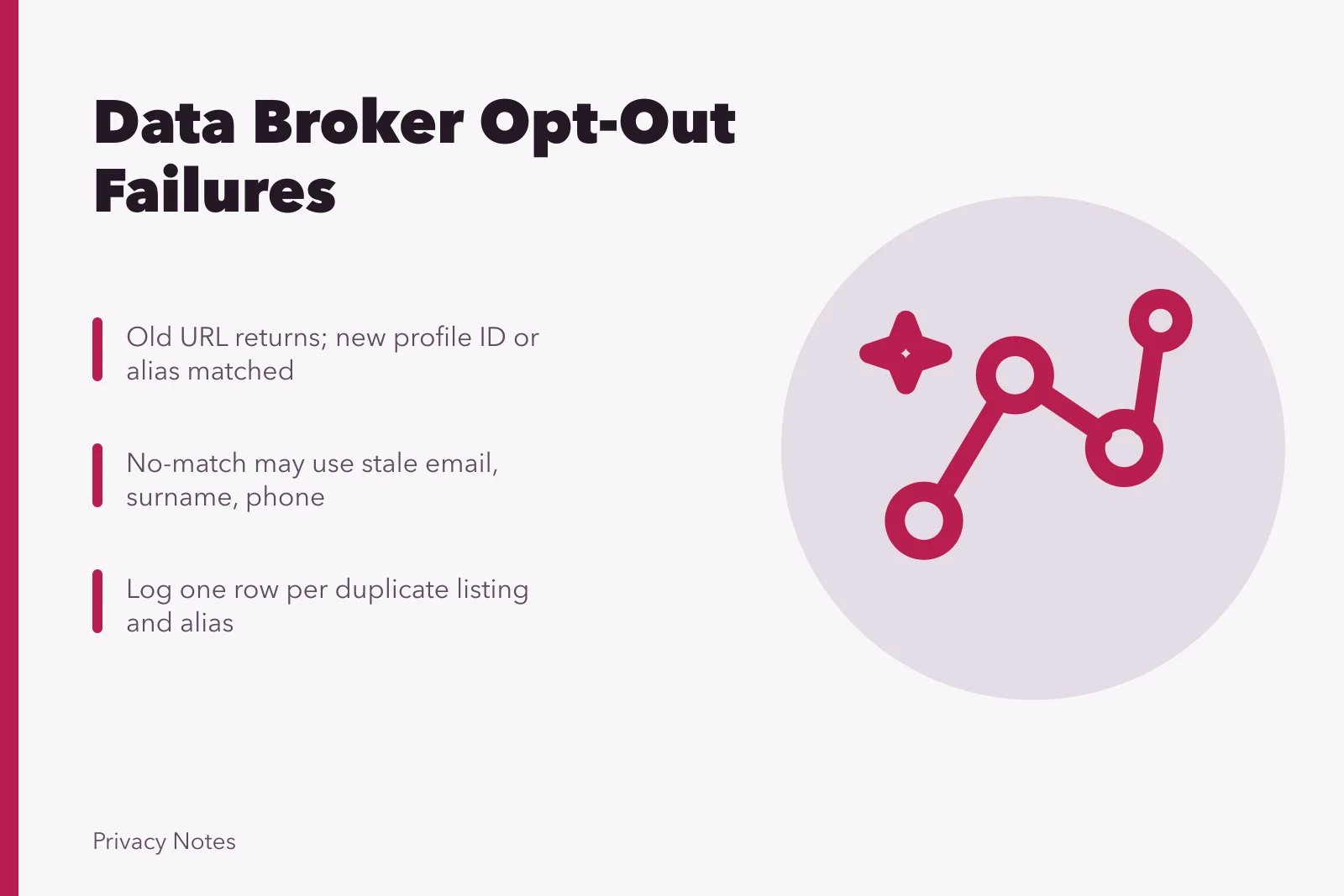
The broker may have received a later source file, created a new profile ID, matched an alias, or suppressed only a prior display. A search engine may also show a stale snippet after the source changed.
Response
Capture the new URL, date, and fields. Compare it with the earlier request and confirmation. Ask whether the earlier action covered future recollection, all identifiers, and every product. Submit a new request only for the unresolved record.
Broker reports no match
A no-match result does not answer every question. The broker may use an old email, former surname, recycled phone number, device identifier, or a household match not included in the request.
No-match response checklist
- Ask which matching fields are accepted
- Ask if another request type applies
- Ask if listing ID identifies record
- Preserve public result conflicting with no-match
Do not respond by sending every identifier you possess. Ask which matching fields the process accepts, whether another request type applies, and whether a visible listing ID can identify the record. Preserve the public result that conflicts with the no-match response.
California's explanation of personal information and data brokers in DROP describes matching from submitted identifiers, not-found results, partial deletions, and the distinction between data obtained indirectly and information provided directly to a business. That explanation concerns California's DROP system and should not be generalized to every broker or jurisdiction.
Identity proof feels excessive
Warning signs
Excessive ID request warning signs
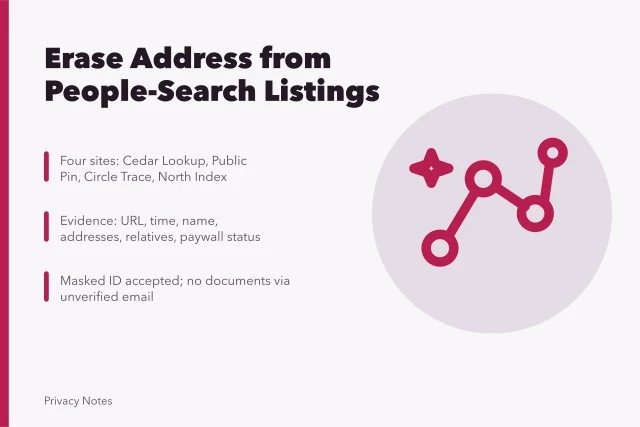
- Unmasked government ID requested by email
- Upload host differs from disclosed processor
- Social Security number unrelated to listing
- No purpose, retention, security, or alternative
- Support pressures sending documents outside form
Pause. Verify the domain and legal entity independently. Ask which fields are required and whether they may be masked. Request another verification method. If a law applies, use its complaint or appeal process instead of sending questionable proof.
Duplicate profiles remain
One company may assign separate profiles to a maiden name, nickname, old city, new city, or merged household. A request tied to one URL may leave the others untouched.
Duplicate profile handling steps
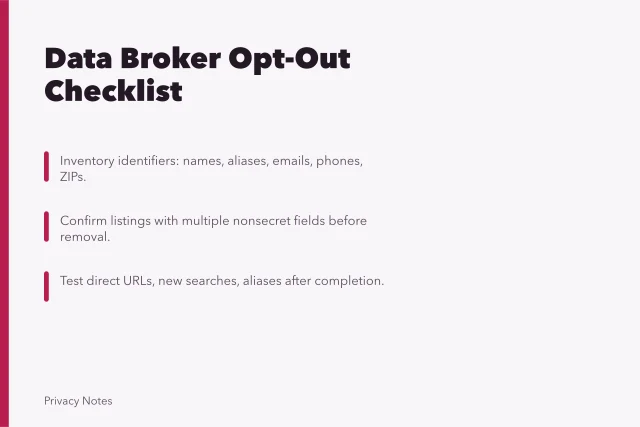
- Create one row per listing
- Record distinguishing fields for each result
- Ask if request covers all aliases
- Do not claim uncertain matches
A relative's page exposes the person
A removed profile may still appear as an associate, household member, or possible relative on someone else's page. The relative's profile is not automatically yours to control.
Document the specific exposure. Review whether the service provides a route for the named person, an authorized agent, or a safety exception. Coordinate carefully with the relative when safe. Avoid spreading the page in group messages or public posts.
Public records remain
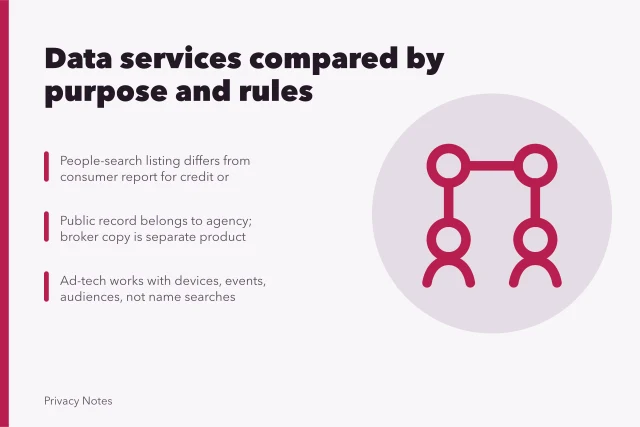
Commercial suppression usually does not change an official property, court, licensing, voter, or business record. Identify the issuing office and its correction or confidentiality authority. Do not demand factual deletion from an office that must retain the record.
Where safety is involved, ask a qualified advocate or lawyer about sealing, redaction, substitute addresses, or confidentiality programs. Availability and eligibility vary.
Search results lag behind
A search engine can retain a title or snippet after a source page changes. First verify the source URL. If the page still displays the information, return to the broker. If the source is gone but the snippet remains, use the search provider's published update or personal-information route.
Record what appears in the snippet and what appears on the source page. They are separate systems and may require separate requests.
Opt-out did not stop spam or fraud
Removing a profile cannot recall every downstream copy or identify the cause of each call, message, or account attempt. Treat continued abuse as an incident with its own evidence.
The FTC's guidance on what to know about identity theft lists warning signs, credit freezes and fraud alerts, document protection, account safeguards, monitoring, and reporting routes. Use those steps when personal information is being misused. An opt-out confirmation alone does not resolve identity theft.
Escalation packet
Prepare a short packet containing:
- the exact listing or product;
- the original request and confirmation;
- the observed unresolved field;
- screenshots with URLs and dates;
- the requested correction or action;
- the applicable response or denial;
- safety urgency, stated without unnecessary personal detail.
Send it only through the official company, regulator, platform, advocate, or legal channel appropriate to the failure.
Common questions
Why did my profile return after removal?
Common causes include new source data, another profile ID, a matched alias, or suppression limited to one product or date.
Should I send more ID after a no-match reply?
Ask what is necessary and verify the channel first. More identity data can create risk without resolving the mismatch.
Can I remove myself from a relative's report?
Possibly, depending on the service, authority, and applicable rights. Identify the specific association and use the service's verified process.
Does an opt-out stop identity theft?
No. It may reduce exposure in a particular product. Active misuse requires account, credit, reporting, and recovery actions suited to the incident.