Features
Removing a fictional home address from several people-search listings case
Fictional people-search case removing a home address through evidence capture, safe requests, family coordination, source review, result tests, and monitoring.
What to take away
Removing a fictional home address from several people-search listings case starts with evidence, not a mass report.
- The fictional team treated the exposed address as a safety issue, not a marketing nuisance.
- It preserved evidence before contacting sites and shared the evidence only with authorized helpers.
- Each listing was classified by company, URL, person named, source claim, and request route.
- The team minimized identity proof and did not send documents through unverified email.
- Removing one profile did not remove public records, relatives' associations, or search snippets.
- A 180-day monitoring plan caught one reappearing record without turning every search into a crisis.
- Four listings were reduced, and one reappeared at day 92.
This case is fictional. It teaches process and does not report a real person, address, broker, threat, or outcome. The fictional case's names, services, dates, and events are invented. The real services named later are public companies with public opt-out pages.
Situation
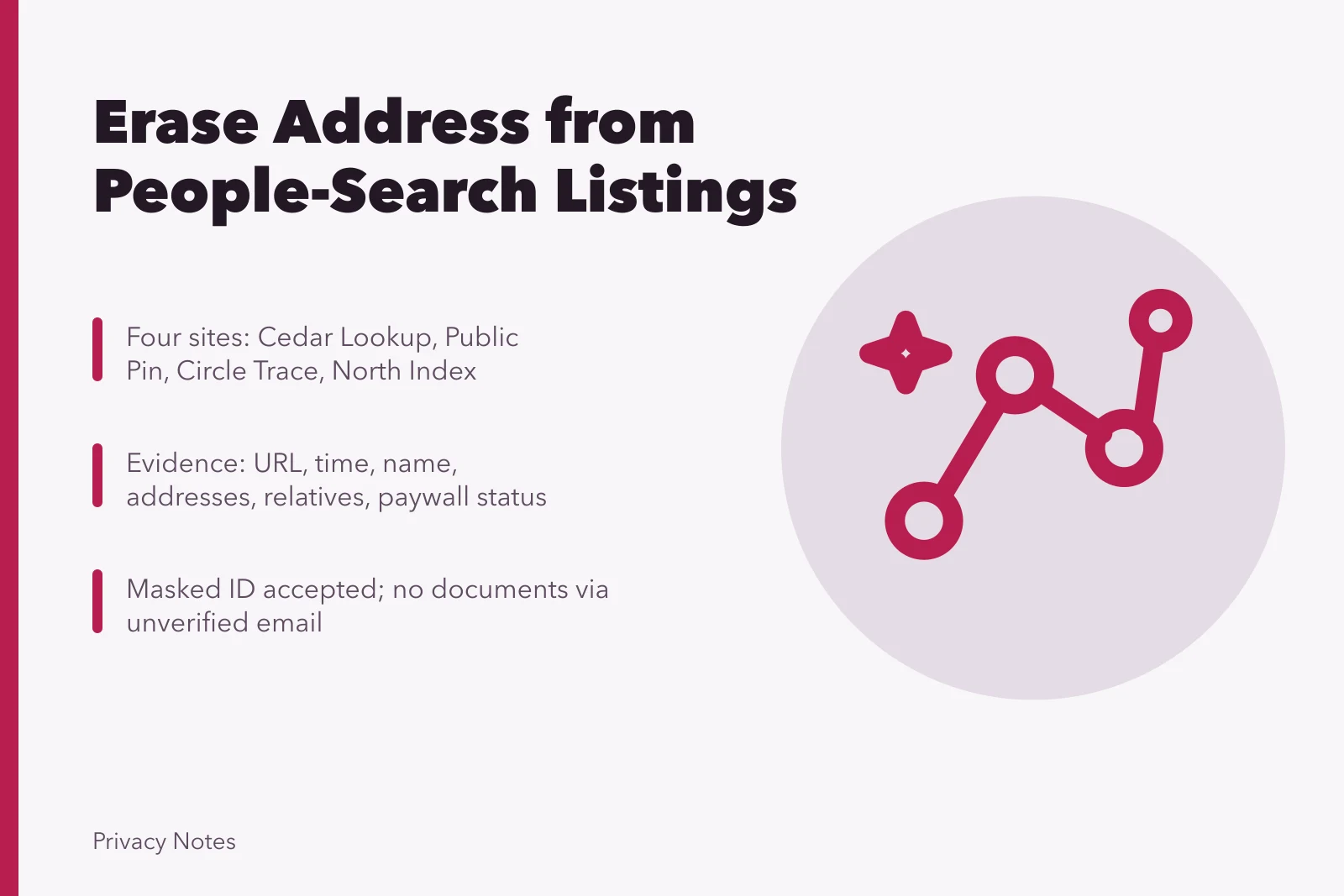
Jordan Hale discovered that a current home address appeared on four fictional people-search sites after an unwanted contact referenced the neighborhood. Jordan had recently moved after repeated harassment. A victim advocate, Dana, helped organize the response with Jordan's consent.
The goal was narrow: reduce public address discovery while preserving evidence, checking the original sources, and avoiding new disclosure through removal forms.
First-hour decisions
Jordan did not post the pages publicly or ask friends to mass-report them. Dana created an encrypted case folder and recorded:
- The full listing URL and the site name.
- Screenshots with the browser address bar and a visible timestamp.
- The person named and every data field shown.
- The source cited by the listing, if any.
- The date and time of the unwanted contact.
- The names of people allowed to access the folder.
First-Hour Evidence Checklist
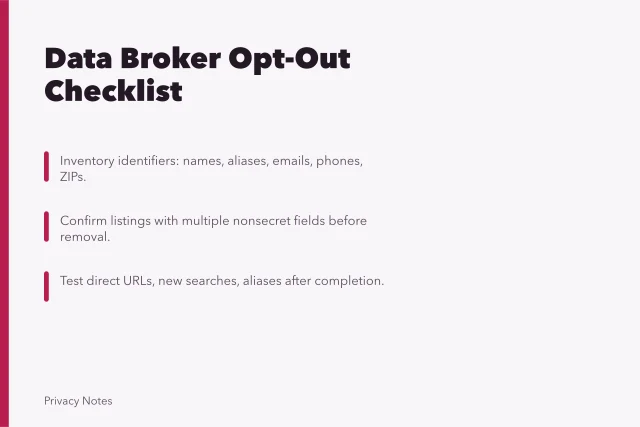
- Exact URL and time
- Name shown on listing
- Current and former addresses
- Phone numbers and age range
- Displayed relatives
- Free, previewed, or paywalled
- Search query that found it
Screenshots preserved the browser address bar. Dana also saved the unwanted contact and its time separately. Only Jordan, Dana, and a lawyer could access the evidence.
CISA's personal security considerations action guide describes doxing risk, limiting public personal information, opting out of major broker and people-search sites, documenting incidents, reporting threatening publication, and working with site administrators. The guide informed the fictional evidence and containment plan. It does not verify this case or guarantee that opting out removes a threat.
Classifying the four listings
The four results looked similar but differed in scope.
| Fictional site | What appeared | Match confidence | Request route |
|---|---|---|---|
| Cedar Lookup | Current address and phone number | High | Record URL and email confirmation |
| Public Pin | Current address, former alias, and city | High | Name, former alias, current address, and masked photo ID |
| Circle Trace | Jordan's association with a sibling | Medium | Association review route with sibling verification |
| North Index | Stale search snippet with no live source page | Low | Snippet refresh request to the search provider |
Four Listings, Four Routes
Cedar Lookup
- What appeared
- Name, address, phone
- Match confidence
- High
- Request route
- Suppression form
Public Pin
- What appeared
- Address via old alias
- Match confidence
- High
- Request route
- Privacy portal
Circle Trace
- What appeared
- On sibling's profile
- Match confidence
- Medium
- Request route
- Support review
North Index
- What appeared
- Snippet only
- Match confidence
- Uncertain
- Request route
- Snippet refresh
This classification prevented one form submission from being treated as four completed removals.
Real-service reference
The pages below are public opt-out pages at real services. Requirements can change, so confirm each page before sending data.
| Real service | What it is | Opt-out route and requirement |
|---|---|---|
| Spokeo | People-search reports | spokeo.com/optout; profile URL and email confirmation |
| Whitepages | People and phone lookup | whitepages.com/suppression-requests; listing URL and phone verification |
| BeenVerified | Background reports | beenverified.com/app/optout/search; email and profile URL |
| TruthFinder | Background check reports | truthfinder.com/optout; email and profile URL |
| PeopleFinders | People-search reports | peoplefinders.com/opt-out; profile URL and email |
| FastPeopleSearch | Free people-search listings | fastpeoplesearch.com/removal; profile URL and email |
Safe request sequence
Dana navigated independently to each site's privacy page and compared the domain with the listing. Cedar Lookup required the record URL and an email confirmation. Jordan used a monitored alias that forwarded to a protected account.
Safe Request Sequence
- Navigate independently to each privacy page
- Compare domain with listing
- Cedarrecord URL and email confirmation
- Public Pinask about masking ID
- Circle Traceexplain association, not control
- North Indexrequest snippet refresh
Public Pin requested name, former alias, current address, and a photo ID. Dana asked whether the ID could be masked. The service confirmed that the ID number and photograph were unnecessary, while name and address had to remain visible. Jordan uploaded the masked copy through the verified portal and saved the retention statement and receipt.
Circle Trace named Jordan's sibling as the profile subject. With Jordan's permission, Dana explained the exposed association without claiming control of the sibling's whole record. The service offered an association-review route. The sibling later submitted a separate request voluntarily.
North Index no longer displayed a source page. Dana recorded the missing source and requested a snippet refresh from the search provider rather than sending identity evidence to the dead domain.
Upstream source review
Two listings cited a property filing created before Jordan entered the safety plan. The filing was accurate, so an ordinary correction request would have been false. Jordan's lawyer checked the recorder's rules and available confidentiality protections.
A Department of Justice report on anti-stalking enforcement practices says address confidentiality programs can give eligible victims a substitute address for some public-agency interactions. Programs and requirements vary, and enrollment does not guarantee safety.
The fictional team used that concept to ask the state program about future records. It did not assume enrollment would rewrite the old filing.
Jordan also changed a public business contact page from the residential address to an authorized mailing address. That reduced a direct upstream source without falsifying an official record.
Outcomes after 30 days
- Cedar Lookup's direct page returned a removal confirmation.
- Public Pin removed the current address but retained an old city, consistent with its response.
- Circle Trace removed Jordan's association after separate verification by the sibling.
- North Index stopped showing the stale snippet after its refresh cycle.
Dana tested the original URLs and queries in a fresh signed-out session. She recorded each field that remained instead of marking an entire company complete.
30-Day Outcomes
- Cedar LookupRemoval confirmation
- Public PinCurrent address removed, old city retained
- Circle TraceAssociation removed after sibling verification
- North IndexStale snippet stopped after refresh
Reappearance at day 92
Public Pin created a new listing ID after receiving an updated marketing file. It displayed Jordan's mailing address, not the residence. The team still requested suppression because the combined name, alias, and city narrowed the search.
Reappearance at Day 92
- Day 92New Public Pin listing ID appears
- Day 92Mailing address shown, not residence
- Day 92Suppression requested with earlier confirmation
- Day 101Second listing disappeared
The new request referenced the earlier confirmation and new listing ID. Jordan did not resend an ID because the account's verified request history was sufficient. The second listing disappeared nine days later.
What the team did not claim
The removals did not prove that all downstream copies were gone. They did not establish who made the unwanted contact or where that person found the address. The address confidentiality inquiry did not guarantee eligibility. A missing search result did not mean the official property filing was sealed.
Those limits kept the final record accurate and left clear tasks for safety, legal, and privacy support.
Reusable case record
The final log contained the evidence hash, access list, four listing rows, request receipts, outcomes, upstream-source notes, safety referrals, and review dates at 30, 90, and 180 days. Redundant ID copies were deleted after confirmation. The protected original evidence remained under the lawyer's retention instructions.
Common questions
Why preserve a page before asking for removal?
It documents what was exposed, when it appeared, and which URL was involved. That can support safety reporting and later disputes.
Why not ask friends to report every page?
It would spread the address, increase uncontrolled copies, and create inconsistent requests. Jordan used a small authorized team.
Did the substitute address remove old records?
No. The team asked about protecting future agency interactions and treated the older filing as a separate legal question.
Was the unwanted contact traced to a broker?
No. The case established exposure and reduced it, but it did not prove the contact's source or identity.
Which real people-search services should I check first?
Start with the six in the table: Spokeo, Whitepages, BeenVerified, TruthFinder, PeopleFinders, and FastPeopleSearch. Each has a public opt-out page, but requirements and prices can change.