Guides
Cross-border data flows PIPEDA: Ontario firms and US partners
Cross-border data flows PIPEDA: how Ontario small firms manage US vendors, document transfers, assess breach duties, and use contracts and technical controls.
What to take away
- Cross-border data flows PIPEDAyou stay accountable for Ontario customer data even after a US vendor receives it, and the OPC expects a written trail.
- Breach notification timing runs from the moment you have a real risk of significant harm, not from the end of the vendor's investigation.
- Contract clauses on subpoena notice, lawful access and deletion are what keep a US court order from silently emptying your records.
- Encryption, data residency and least-privilege access limits are the technical half of the same duty.
- A short vendor review before every renewal is cheaper than a breach report after one.
What PIPEDA accountability means when data crosses to a US vendor
PIPEDA is built on ten fair information principles. The one that matters most when data leaves Ontario is accountability. It says an organization is responsible for personal information in its possession or custody, including information transferred to a third party for processing. You can hand over the work. You cannot hand over the responsibility.
The Office of the Privacy Commissioner of Canada states the point plainly: using a third party to process personal information does not remove your obligations. The OPC's guidance for businesses treats a transfer for processing as a use by the original organization, not a disclosure to a new one.
That distinction decides what consent you need and what you must document.
For an Ontario firm, the practical result is a paper trail. You need to know which US vendors touch customer data, what they do with it, where it sits, and who at your company signed off. A PIPEDA compliance checklist is the cheapest way to keep that trail current.
Federal and provincial rules overlap. In the course of commercial activity, PIPEDA governs private-sector organizations that gather, use, or share personal information. The OPC's summary of privacy laws in Canada is the place to confirm which statute governs a given data set, since a single transfer can sit under more than one regulator.
What US law adds
US law does not replace PIPEDA; it adds a lawful-access risk. Under the CLOUD Act, the Stored Communications Act can reach data held by a provider subject to US jurisdiction, even when stored abroad. FISA, including Section 702, provides another route for certain intelligence collection from providers. These laws do not mean every US provider can disclose every record, but a demand may come with limits on notice.
State privacy and breach laws may also apply based on the people and activities involved. Examples include the California Consumer Privacy Act, as amended by the California Privacy Rights Act, California Civil Code section 1798.82 (the state's breach-notification law), and New York's SHIELD Act. The Federal Trade Commission and state attorneys general are potential regulators, depending on the law and facts.
Canadian firms can seek export guidance through the Trade Commissioner Service and explore CanExport SMEs support. Neither changes privacy duties or makes a transfer compliant.
Choosing a transfer mechanism and documenting it
There is no adequacy decision that lets you send Ontario personal information to the United States without conditions. Transfers for processing are allowed under PIPEDA when the receiving organization is bound to provide a comparable level of protection. You prove that with a contract and with oversight, not with a checkbox.
Two US transfer mechanisms you will see in vendor paperwork do not do the job here. The EU-US Data Privacy Framework is an adequacy arrangement between the European Union and the United States. It says nothing about Canadian transfers under PIPEDA.
European Commission standard contractual clauses are GDPR export tools, so signing them does not satisfy PIPEDA on its own. They still carry weight as evidence. A vendor that accepts defined processing limits, audit rights and deletion duties has shown it can meet the comparable-protection test.
Ask which instrument your contract relies on. Check that the US entity holding the data is the one that signed the terms.
Start by classifying the data. A US email marketing tool that holds names and addresses is a different risk from a US analytics platform holding purchase histories tied to identifiers. Health data, financial data and data about children raise the bar further.
Then pick the mechanism that fits the relationship.
Choosing a transfer mechanism
- Service provider contract. The vendor processes only on your instructions, for your purposes, and returns or deletes the data at the end.
- Group or affiliate transfer. A parent or sister company receives the data under an internal policy that meets PIPEDA standards.
- Consent-based transfer. The individual is told the data will go to a named country and a named recipient, and consents.
- Data localisation. The data stays in Canada and only de-identified or aggregated results cross the border.
The choice should be recorded. A one-page transfer memo naming the vendor, the data categories, the mechanism, the retention period and the reviewer is enough for most Ontario small firms. Date it and revisit it at renewal.
A vendor risk assessment should feed that memo. Ask what the vendor does with data at rest, who inside the company can see it, how long it is kept, and what happens on termination. If the answers are vague, the mechanism is not ready.
Documenting the decision
Keep the vendor's privacy policy, its security evidence, your signed agreement and your own approval note in one folder. Ask for a SOC 2 report, ISO/IEC 27001 certification, or evidence that the vendor's controls align with the NIST Cybersecurity Framework. If the OPC or a provincial regulator asks, you want to produce the file in minutes rather than reconstruct it from email.
Breach notification timing when the incident happens in the US
A breach at a US vendor is your breach if the data is Ontario customer data. PIPEDA requires you to report to the OPC any breach of security safeguards involving personal information under your control where it is reasonable to believe the breach creates a real risk of significant harm.
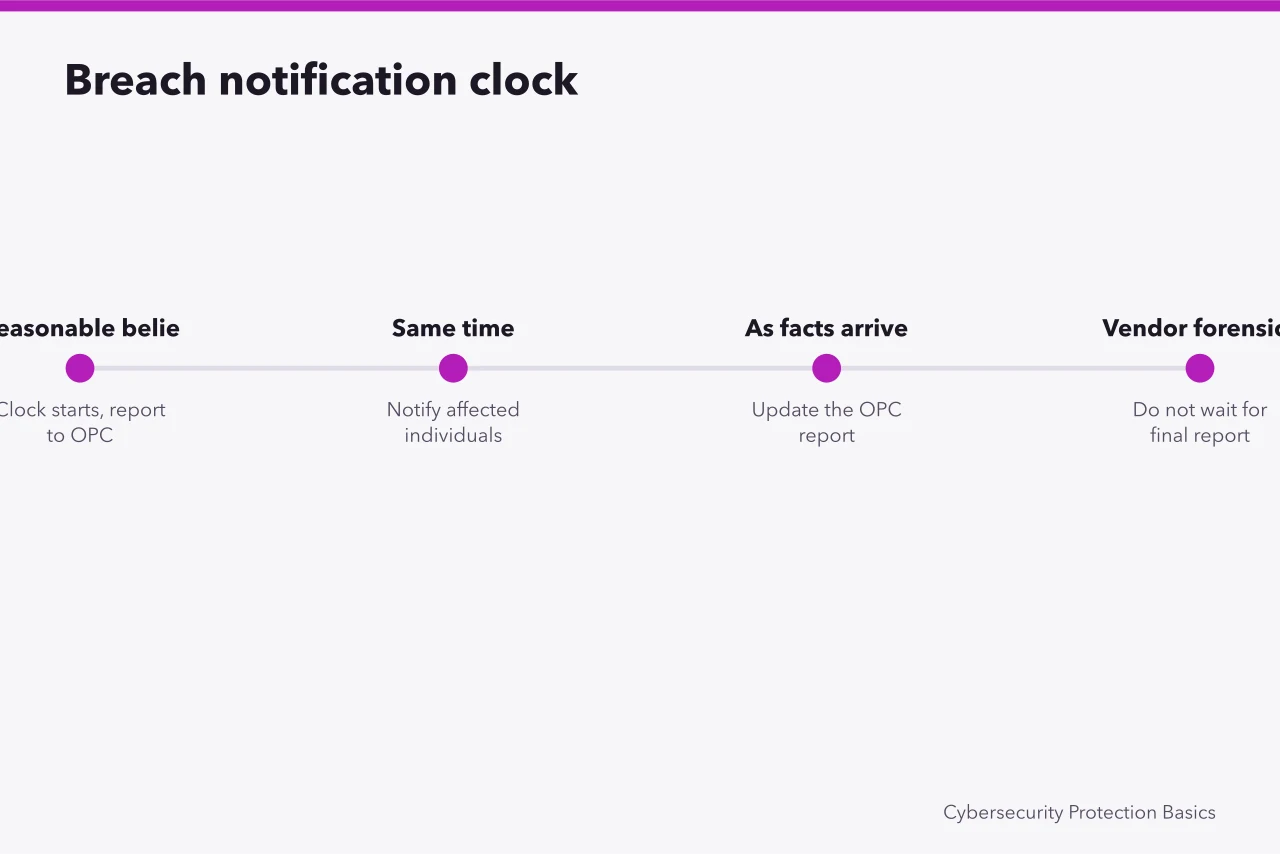
You must also notify affected individuals and, in some cases, other organizations.
The clock starts when you have that reasonable belief, not when the vendor finishes its forensics. A US provider may take weeks to confirm scope. Waiting for the final report is a mistake. Report on what you know, and update as facts arrive.
A short decision rule keeps the clock honest. Start it on the earlier of two events: your own staff or a customer learns that data under your control may be exposed, or the vendor confirms a suspected breach touching your data. The scope can stay unknown. The clock still runs.
Significant harm covers bodily harm, humiliation, damage to reputation or relationships, and loss of employment or business opportunities. It also includes financial loss, identity theft, negative effects on a credit record and damage to property. The OPC's business guidance explains how to assess this.
The PIPEDA text at the Department of Justice sets out the notification provisions. Use the OPC's online PIPEDA breach report form, available through its Report a breach of security safeguards page, to file with the OPC. Keep a copy of the relevant sections with your incident response plan so nobody has to look them up at 2 a.m.
The vendor clause that buys you time
Your contract should require the vendor to notify you of a confirmed or suspected breach within hours, not days. Typical terms run from 24 to 72 hours from discovery, with 24 hours common where health or financial data is involved.
Sample wording: "The Provider will notify the Customer of any confirmed or suspected breach affecting Customer Data within 24 hours of discovery." "Notice will name the data categories involved, the number of individuals affected and the containment steps taken."
It should also require the vendor to preserve logs and to give you the facts you need for your own report. Without those clauses, you learn about the incident from a customer.
If the breach touches a telecommunications service, separate reporting duties may apply. The CRTC's breach reporting rules sit alongside PIPEDA for those providers.
Contract clauses that survive a US subpoena
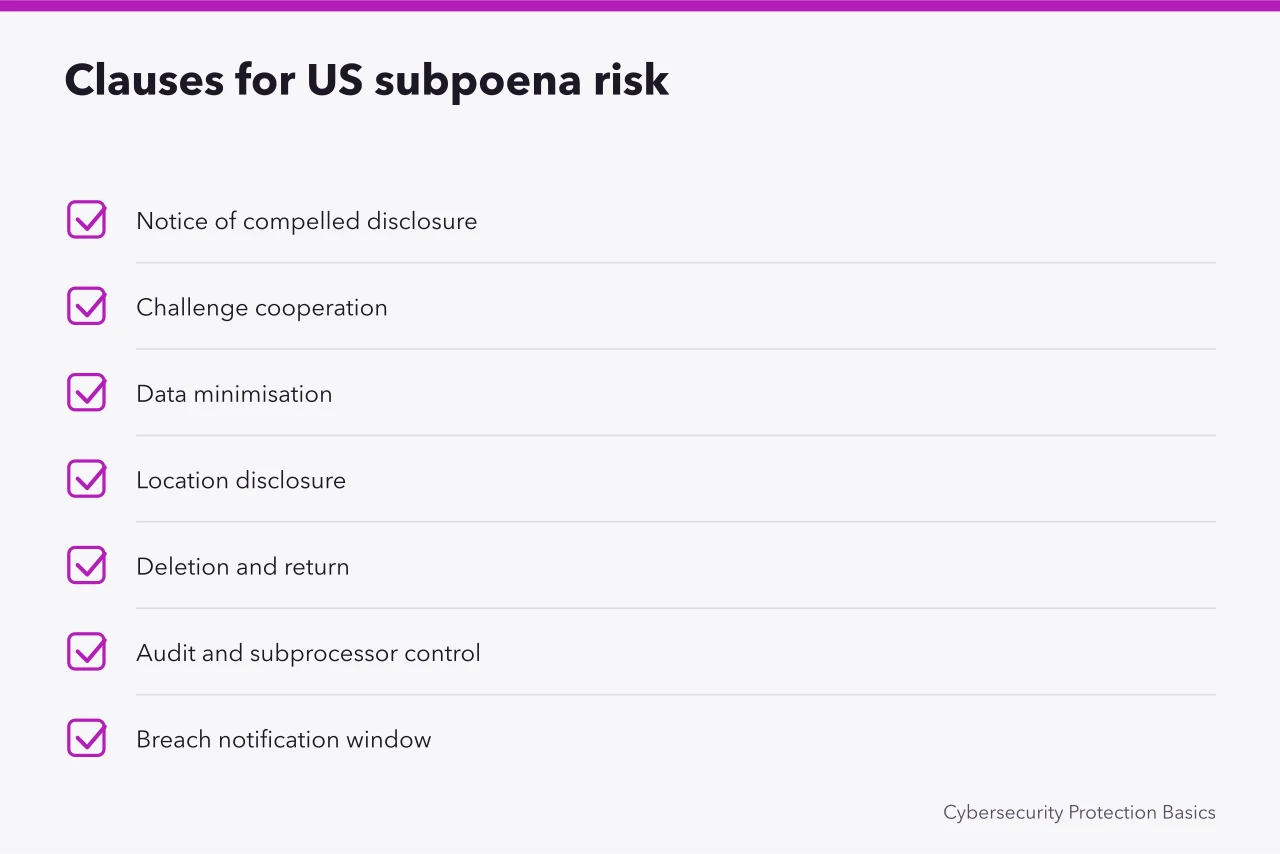
A US subpoena or national security letter can compel a US-based provider to hand over data and to stay silent. You cannot contract your way out of US law. You can contract for the notice, the challenge and the record you need when it happens.
Build these clauses into every agreement where personal information crosses the border.
Lawful access notice. "If the Provider receives a subpoena, court order or other legal demand for Customer Data, it will notify the Customer before producing any data unless prohibited by law." "It will disclose only the minimum amount required and will keep a record of what it handed over."
Deletion certification. "Within 30 days of termination the Provider will delete or return all Customer Data, including copies held in backups." "An officer of the Provider will certify the deletion in writing."
Challenge. "The Provider will consult the Customer before it agrees to any demand, and the Customer may direct and fund an objection."
A Canadian court order and a US court order can both reach the same data. The contract cannot decide which wins. It can decide who tells you, who pays for the fight, and whether the data still exists in a form worth seizing.
Why Ontario firms feel this first
Ontario's economy is tied closely to US customers, suppliers and platforms. A Toronto software firm may sell to US clients, host on US infrastructure and buy marketing services from a US vendor. Each of those links is a cross-border flow, and each needs the same clause set.
Ontario's Personal Health Information Protection Act, 2004 (PHIPA), overseen by the Information and Privacy Commissioner of Ontario (IPC), applies to personal health information in covered settings. Ontario's Consumer Reporting Act sets rules for consumer reporting agencies and consumer reports. Check whether your role and data trigger either statute; neither is a general privacy law for every small firm.
Technical controls: residency, encryption and access limits
The technical side is often the faster win for a small firm.
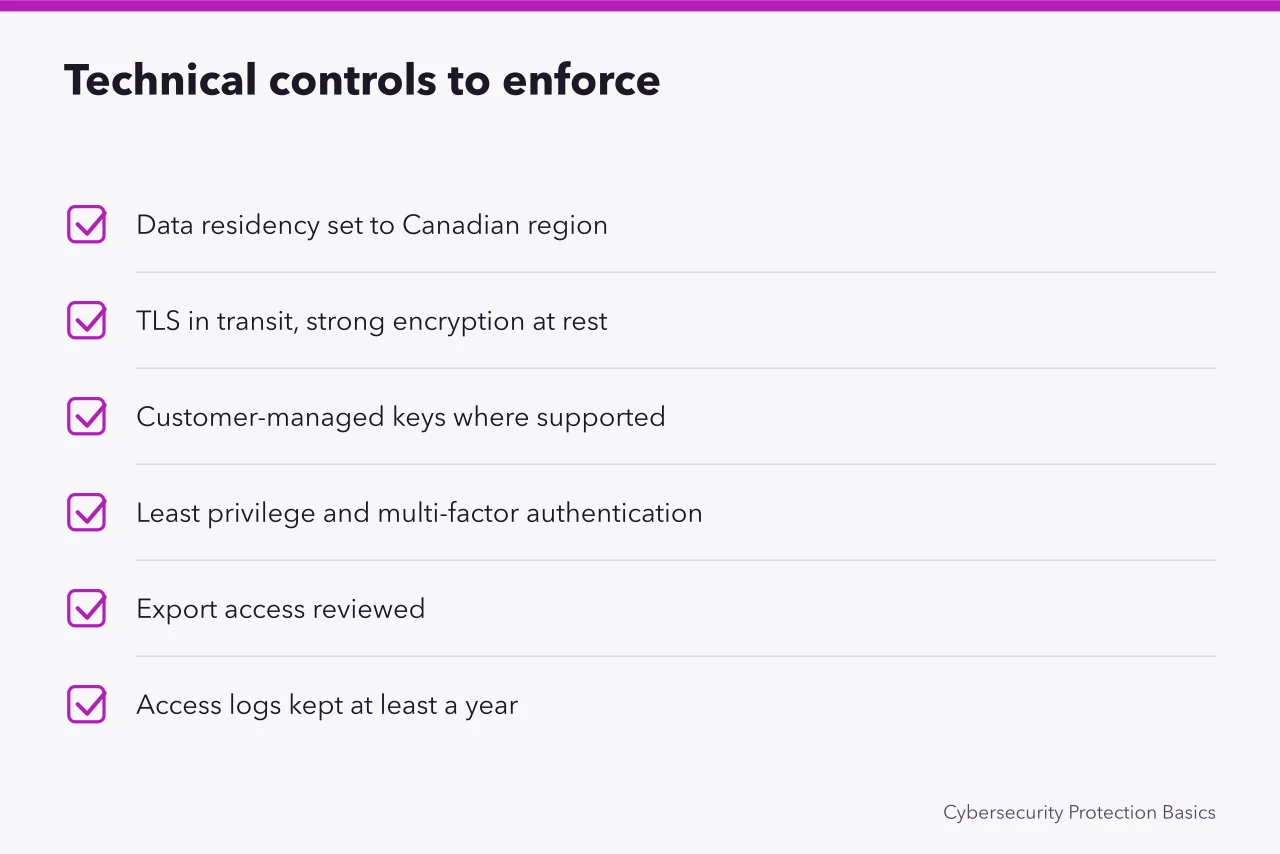
Data residency comes first. Decide which data must stay in Canada and configure the vendor accordingly. Many US platforms offer Canadian regions. Use them for customer records, and keep only de-identified data in the default US region.
Encryption comes next. Use TLS for data in transit and strong encryption for data at rest, with keys you control where the vendor supports it. Customer-managed keys mean a seized backup is not readable without your cooperation.
Access limits do the rest. Apply least privilege, require multi-factor authentication, and review who can export data. An identity and access review catches the accounts nobody remembers creating.
Logging matters too. Keep access logs for at least a year, in a system the vendor cannot silently edit. If a US order is served, those logs are your evidence of what was actually taken.
A worked example
An Ottawa marketing firm stores 40,000 Ontario customer records in a US email platform. The platform's default region is in the United States.
The firm moves the customer records to the vendor's Canadian region, keeps only campaign statistics in the US region, and enables customer-managed encryption keys. The contract adds a 24-hour breach notice, a lawful access notice clause, and deletion certification at termination.
The transfer memo records the mechanism and the reviewer. Typical figures: two to four days of staff time across the review and the migration, and a plan upgrade of roughly 10 to 20 percent on the list price for a Canadian region and customer-managed keys. Treat those as typical ranges, not quotes.
A cross-border vendor review checklist for Ontario firms
Run this before signing, and again at every renewal. Keep the completed checklist with the contract.
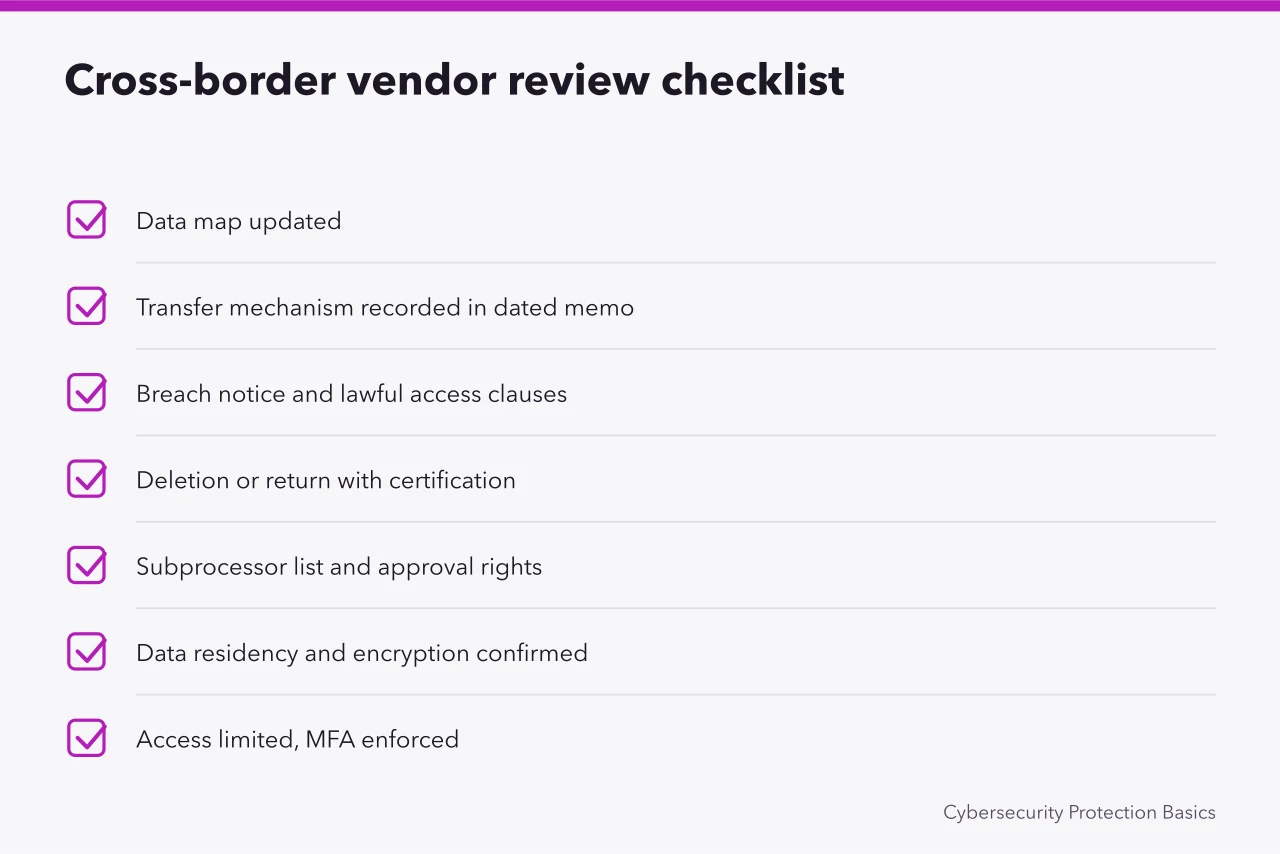
Cross-border vendor review checklist
- Which data categories go to the vendor, and which stay in Canada.
- The transfer mechanismservice provider contract, group transfer, consent or localisation.
- The region where the data is stored and processed, and whether a Canadian region is available.
- The subprocessors the vendor uses, and where they sit.
- Breach notice hours, lawful access notice and deletion certification in the signed agreement.
- Encryption in transit and at rest, and who holds the keys.
- Access controls, multi-factor authentication and export permissions.
- Retention period and the termination deletion timeline.
- The name and date of the internal reviewer who approved the vendor.
Two Ontario-specific points belong on the list as well. First, check whether provincial rules apply to any part of the data, since health and consumer reporting information can sit under Ontario statutes rather than PIPEDA alone.
Second, check your cyber insurance policy: the Insurance Bureau of Canada's guidance on cyber coverage is a useful starting point for what a policy will and will not pay after a US-linked incident.
Small firms can also draw on free Canadian resources. The Canadian Centre for Cyber Security publishes baseline guidance, the Canadian Anti-Fraud Centre handles fraud reports, and the Canadian Federation of Independent Business offers practical material for owners without a security team.
Finally, treat the checklist as a living document. Vendors change regions, add subprocessors and rewrite terms. A review that was accurate in January can be wrong by June.