Guides
Canada to U.S. cloud data transfers, PIPEDA and Schrems-style risks
Canada US data transfers PIPEDA: how U.S. surveillance law, the OPC and cloud contracts shape risk for Canadian data stored with U.S. providers.
What to take away
- Canada US data transfers PIPEDA questions turn on accountability: a Canadian organization stays responsible for personal data it hands to a U.S. cloud, SaaS or email provider.
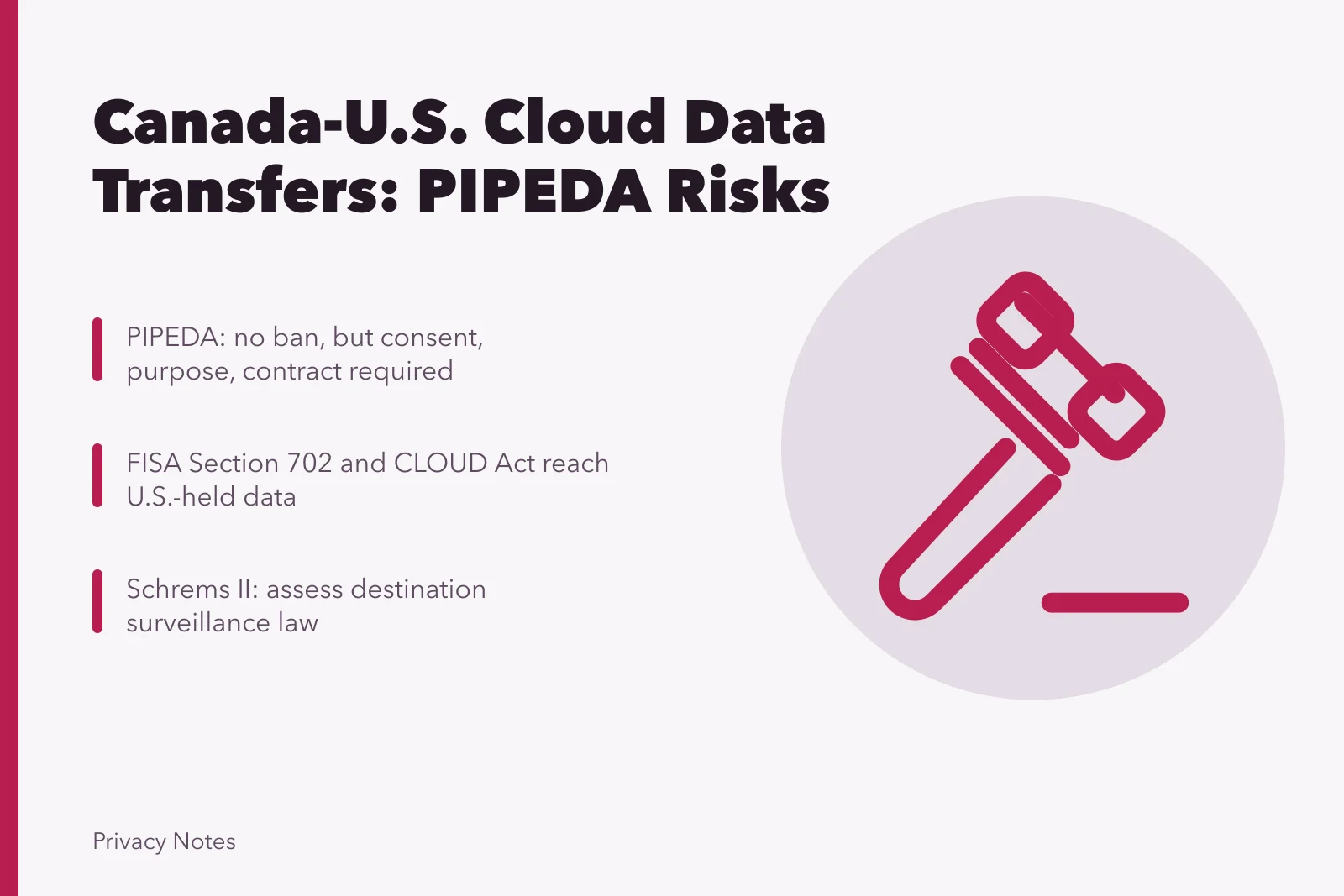
- PIPEDA has no ban on sending personal data to the United States. It requires consent, a stated purpose, comparable protection and a written contract.
- U.S. surveillance law, including FISA and the CLOUD Act, can reach data held by U.S. providers even when the data sits in a Canadian region.
- Schrems-style litigation in Europe keeps moving the goalposts on adequacy and safeguards, and Canadian expectations tend to follow.
- Contracts alone rarely settle the matter. Encryption with keys you hold, regional hosting and tight access controls do more of the work.
- Provincial rules matter tooQuebec's Law 25, British Columbia's public sector regime and Alberta's health rules add their own transfer conditions.
What leaves Canada when you use U.S. cloud, SaaS and email
The obvious answer is the data itself: names, addresses, employee records, customer files, health notes, payment details. The less obvious answer is everything around it. Metadata, access logs, support tickets, backups and the provider's own administrative records all leave Canadian jurisdiction when a U.S. company operates the service.
What Leaves Canada
- Payroll data to U.S. SaaS data centre
- Account records, billing, support chat at U.S. parent
- Email, attachments, calendar, contacts on U.S. mail
- Sub-processors route analytics and support via U.S.
- Subpoena on U.S. parent reaches the whole set
Consider a mid-sized Ontario retailer running payroll on a U.S. SaaS platform. Payroll data goes to a data centre, possibly in Canada. Account records, billing contacts and support chat sit with the vendor's U.S. parent. A subpoena served on that parent reaches the whole set.
Email is the clearest case. A Canadian firm on a U.S. hosted mail service has its messages, attachments, calendar entries and contact graph held by a U.S. corporation. Retention settings and backup copies multiply the exposure. A personal data mapping exercise usually surprises people here, because the vendor list is longer than the finance team thinks.
Sub-processors are the quiet problem. A Canadian SaaS vendor may host in Montreal and still route analytics, error logging or customer support through U.S. providers. Those flows are transfers under PIPEDA even though your contract names only the primary vendor.
Which data is sensitive also matters. Health information, financial records and data about children attract more scrutiny. Quebec's Law 25 requires a privacy impact assessment before transferring personal information outside Quebec in many cases, and the assessment must consider the legal framework of the destination.
So the first step is not legal drafting. It is an inventory: what personal data, whose, where stored, who can reach it, how long kept. The personal data lifecycle checklist is a workable way to run that audit across collection, use, sharing and deletion.
How PIPEDA and the OPC treat cross-border transfers and accountability
PIPEDA is Canada's private sector privacy statute, and the Office of the Privacy Commissioner of Canada (OPC) oversees it for federally regulated businesses and for organizations in provinces without substantially similar law. The OPC publishes plain guidance on the privacy laws in Canada that apply to organizations, including which provinces have their own statutes.
PIPEDA does not prohibit cross-border transfers. It applies a principle of accountability instead. An organization that transfers personal information to a third party, including a service provider in another country, remains responsible for that information. The OPC has said this in guidance and in findings from investigations into outsourcing arrangements.
The practical requirements are familiar. You need a purpose for the transfer, consent that covers it, and protections comparable to what PIPEDA requires. The OPC's privacy guidance for businesses sets out consent and safeguarding expectations that apply whether the recipient sits in Mississauga or Missouri.
Consent is where many organizations get sloppy. A generic privacy policy line about service providers is weak. The OPC expects meaningful information about the fact that data may be handled in another jurisdiction and that foreign law may apply. For sensitive data, express consent is the safer route.
Accountability also means you must be able to answer questions about the transfer. If a customer asks where their data goes, the organization should know. If the OPC investigates, the organization must show the contract, the safeguards and the oversight. Delegation of processing is allowed; delegation of responsibility is not.
Provincial commissioners run parallel regimes. The Office of the Information and Privacy Commissioner of Ontario covers provincial public bodies and health information custodians. The Office of the Information and Privacy Commissioner for British Columbia and the Office of the Privacy Commissioner of Alberta do similar work in their provinces. Quebec's Office of the Privacy Commissioner (CAI) enforces Law 25.
U.S. surveillance law exposure: FISA, CLOUD Act and third-party doctrine
The risk that preoccupies boards is not commercial. It is government access. Two U.S. statutes matter most.
Section 702 of the Foreign Intelligence Surveillance Act (FISA) authorizes collection of communications of non-U.S. persons outside the United States, and it operates through directives to U.S. electronic communication service providers. A Canadian company's data held by a U.S. provider can fall inside that collection when the provider is compelled to assist.
The CLOUD Act, passed in 2018, clarified that U.S. authorities can compel U.S. providers to produce data they control, regardless of where the data is stored. A U.S. provider's Canadian data centre is not a shield. The provider remains subject to U.S. legal process, and it may be barred from telling you about it.
Then there is the third-party doctrine, a U.S. constitutional principle holding that information voluntarily shared with a third party carries reduced Fourth Amendment protection. The Supreme Court narrowed it in Carpenter v. United States in 2018 for cell site records, but the doctrine still shapes how U.S. courts treat data held by service providers.
What does this mean in practice? If your provider is a U.S. company, or a subsidiary of one, assume that U.S. legal process can reach your data. That is true whether the data sits in Toronto, Montreal or Vancouver. It is also true for a Canadian provider owned by a U.S. parent.
Canadian law offers no direct counterweight. The OPC has commented on technology and government access questions in its technology guidance, but it cannot bind U.S. authorities. Mutual legal assistance channels exist under the Canada-United States MLAT and the CLOUD Act's executive agreement mechanism, but they are slow and narrow.
The Canadian Centre for Cyber Security (Cyber Centre) advises organizations to treat third-party risk as a security matter, and the Canadian Anti-Fraud Centre handles fraud reports rather than surveillance complaints. Neither body can stop a U.S. order. That reality should shape your architecture, not just your contract.
Schrems-style risk: why adequacy and safeguards keep shifting
Canadian readers watch the European cases because they set the tone. In Schrems I, the Court of Justice of the European Union struck down the Safe Harbour arrangement in 2015. In Schrems II, in 2020, it struck down the Privacy Shield and cast doubt on standard contractual clauses unless the exporter assesses the destination's surveillance law.
The EU and the United States then adopted a new framework, the Data Privacy Framework, in 2023. It relies on U.S. commitments on signals intelligence and a redress mechanism. Legal challenges continue, and the framework's survival is uncertain.
Canada is not in the same position as the EU. The European Commission has recognized Canada as providing adequate protection for commercial organizations under PIPEDA, with a caveat for data about employees. That decision has held, but it is reviewed periodically and it does not cover provincial public sector regimes.
Why does this matter for a Canadian company? Because your European customers, partners and subsidiaries ask about it. A German client may insist on standard contractual clauses, a transfer impact assessment and supplementary measures before sending data to a Canadian subsidiary that uses U.S. cloud. The same questions now arrive from Canadian privacy teams, who borrow the vocabulary.
The lesson from the Schrems line is that paper safeguards alone are fragile. Regulators and courts keep asking whether the destination's laws undermine the promises in the contract. If U.S. surveillance law can override a clause, the clause does not fully answer the question. Technical measures that put the data beyond the provider's reach do.
For a broader treatment of how retention, sharing and security obligations fit together, the personal data privacy guide covers the lifecycle duties that surround any transfer decision.
Contractual steps: data processing agreements, standard clauses and residency options
Contracts are the floor, not the ceiling. They still matter, and a weak one will fail an audit or an OPC inquiry.
Start with a data processing agreement. Under PIPEDA's accountability principle, the organization must use contractual means to ensure the third party provides a comparable level of protection.
A data processing agreement should set out the purpose, the categories of data, the security measures, the sub-processor rules, the breach notification timeline, the audit rights and the return or destruction of data at the end.
Add transfer terms where the data crosses borders. Standard contractual clauses borrowed from the EU model are common, but they must be paired with a transfer impact assessment that examines U.S. surveillance law and the specific data at issue. A clause that ignores the destination's legal reality is decoration.
Push for notification commitments. Ask for notice of government access requests where law permits, and for aggregate transparency reporting. Some providers publish warrant canaries or transparency reports. Treat silence as a data point.
Negotiate residency options. Many U.S. providers offer Canadian regions, and some offer data residency guarantees that keep data at rest in Canada. Read the fine print: residency of storage does not mean residency of support access, backups or metadata. A provider may store in Canada and still let U.S. staff reach the data.
Consider Canadian providers where the risk profile demands it. A provider incorporated and controlled in Canada is not immune to foreign orders, but it faces a different legal starting point. For public sector bodies, provincial rules may require it.
British Columbia's data and information management guidance illustrates how a province handles information management expectations for public bodies and the vendors they use.
Contractual steps
| Contract term | What to ask for | Why it matters |
|---|---|---|
| Data processing agreement | Purpose, data categories, security, sub-processors | PIPEDA accountability requires comparable protection |
| Transfer clauses | Standard clauses plus transfer impact assessment | Schrems-style scrutiny expects a legal analysis |
| Government access | Notice where lawful, transparency reporting | Reveals how the provider handles orders |
| Residency | Storage, support and backup locations named | Canadian storage alone does not stop U.S. access |
| Breach notice | Fixed timeline, defined contact | Enables your own PIPEDA breach reporting |
| Deletion | Certified destruction on exit | Prevents data lingering after the contract ends |
| Audit | Right to assess controls and sub-processors | Gives you evidence for the OPC and customers |
Technical steps: encryption, key custody, regional hosting and access controls
If U.S. legal process can compel a provider, the strongest defence is data the provider cannot read. That is an architecture decision, not a clause.
Encryption is the starting point. Data encrypted in transit and at rest protects against interception and theft, but provider-managed keys leave the provider able to decrypt. For data exposed to U.S. process, that is the gap that matters.
Key custody changes the picture. When your organization holds the keys, in a separate environment the provider does not control, a compelled production order yields ciphertext. This is the practical version of the Schrems supplementary measures discussion. The browser privacy checklist sets out how transport encryption, end-to-end encryption and encrypted backups differ in what they actually protect.
End-to-end encryption suits messaging and some file sharing, but it breaks server-side search, indexing and some compliance features. Choose per workload. Payroll and health data may justify stricter handling than marketing email lists.
Regional hosting helps with latency, data residency commitments and some regulatory expectations. It does not defeat a U.S. order served on a U.S. provider. Treat it as one layer.
Access controls do quiet work. Enforce least privilege, require phishing-resistant multi-factor authentication, log administrative access and review it. Most breaches involving cloud data start with a compromised account, not a secret court order. The data broker privacy guide covers email, messaging and metadata controls in more detail.
Backups deserve separate attention. A backup in a U.S. region reintroduces every risk you removed from production. Map backup locations, test restores and confirm deletion schedules.
- Know which providers hold personal data and where their servers, support staff and backups sit.
- Confirm consent language covers transfers to the United States and names the possibility of foreign law access.
- Hold a signed data processing agreement with transfer terms and sub-processor disclosure for each provider.
- Encrypt sensitive data with keys your organization controls, held outside the provider's environment.
- Restrict administrative access, enforce multi-factor authentication and review logs monthly.
- Document a transfer impact assessment for any provider subject to U.S. law.
- Test exitcan you export data and confirm deletion within a defined period?
Assessing a U.S. provider before you sign
Run the same sequence every time, and record the answers.
U.S. Provider Assessment Steps
- Map data categories, sensitivity and volume
- Establish corporate chain and sub-processors
- Read government access policy and transparency reports
- Test technical controls and key custody
- Check residency claims against reality
- Negotiate data processing and transfer terms
- Set annual review date and triggers
Two institutional habits make this sustainable. First, keep a current register of providers and data flows. Second, brief the people who sign contracts, because procurement decisions made for price or convenience often create the transfer risk that legal then has to manage.
Smaller organizations can borrow the same discipline without a privacy team. A one-page provider sheet, updated twice a year, covers most of what the OPC would ask for. The point is to know where the data is and who can reach it, and to be able to prove you asked.