Features
Separating work, shopping, and personal browsing in a shared laptop case
Fictional shared laptop case separating work, shopping, and personal browsing through device accounts, profiles, sync, permissions, extensions, and cleanup.
What to take away
- This fictional case demonstrates browser separation and makes no claim about a real household or employer.
- Separate operating-system accounts form the main boundary between household users.
- Browser profiles reduce task mixing within one person's device account.
- Work policy takes priority over personal convenience on managed systems.
- Private windows are used for temporary local cleanup, not as an identity boundary.
- Tests cover sync, autofill, downloads, extensions, permissions, and session closure.
Mira and Jonah are fictional adults sharing one fictional household laptop. Mira also has access to a managed work laptop. The scenario, devices, accounts, employer, stores, and results are invented. It is an educational case, not security, employment, or legal advice.
The starting problem
On the household laptop, both people use one operating-system account and one browser profile. Jonah sees Mira's gift-store suggestions. Mira nearly uploads a personal tax file into a work web form. Shopping extensions run during online banking. Both assume a private window separates everything.
The aim is not to hide activity from lawful device administrators or network operators. It is to reduce household access, mistaken account use, unintended autofill, and unnecessary extension exposure.
Define the boundaries
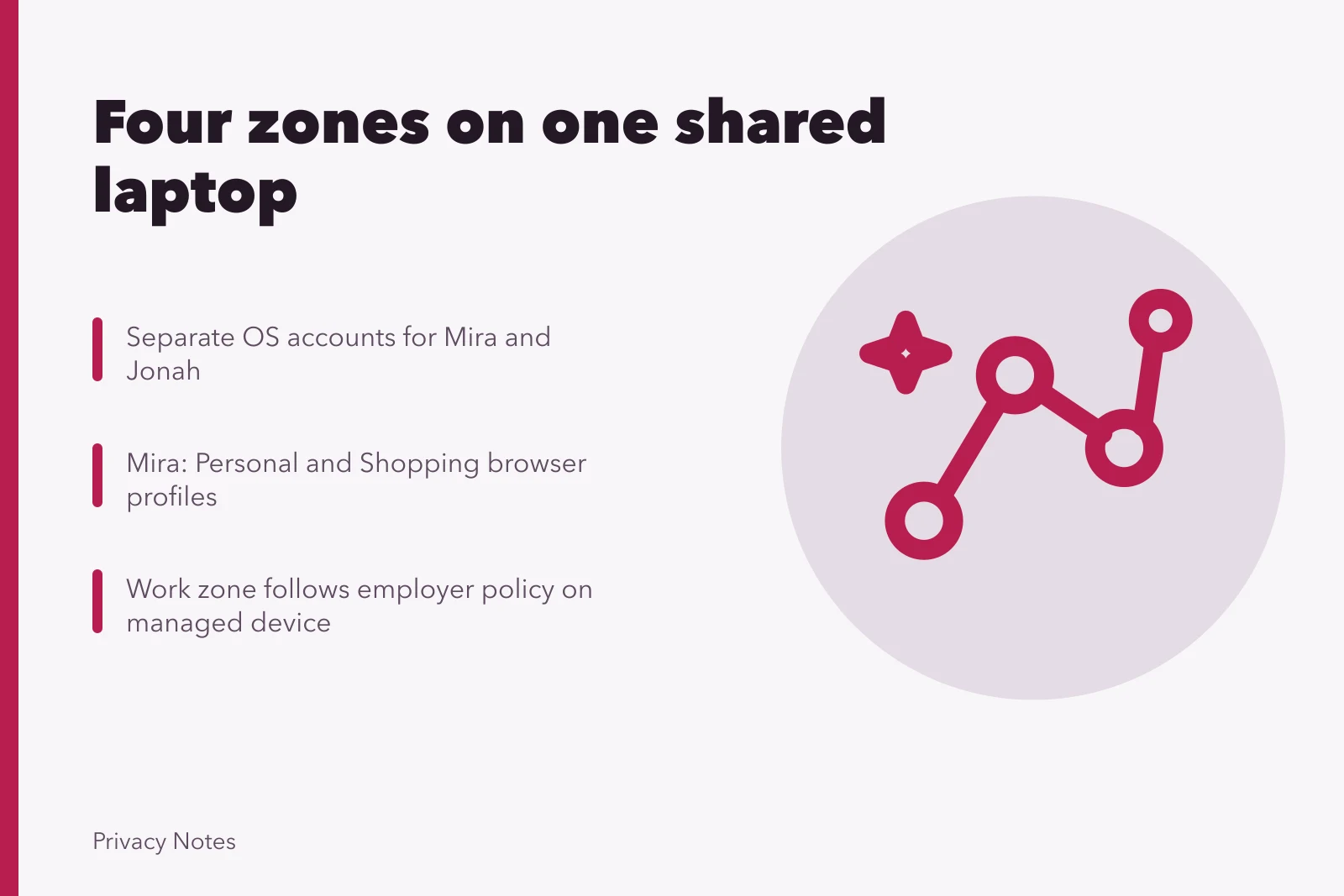
The household writes four zones:
Four Zones Setup
Mira personal
- Device account
- Mira
- Browser profile
- Personal
- Main rule
- No work sync
Mira shopping
- Device account
- Mira
- Browser profile
- Shopping
- Main rule
- No export/banking
Jonah personal
- Device account
- Jonah
- Browser profile
- Personal
- Main rule
- Jonah sync only
Mira work
- Device account
- Managed work
- Browser profile
- Employer-controlled
- Main rule
- Follow policy
| Zone | Device account | Browser profile | Main rule |
|---|---|---|---|
| Mira personal | Mira | Personal | No work account sync |
| Mira shopping | Mira | Shopping | No password export or banking |
| Jonah personal | Jonah | Personal | Jonah's sync only |
| Mira work | Managed work device | Employer-controlled | Follow organization policy |
They choose separate operating-system accounts for household separation because a browser profile alone is not designed to stop another user who can open the same local account.
Build browser profiles deliberately
Within Mira's household account, she creates personal and shopping profiles with different colors and names. She checks the sync identity before importing bookmarks or credentials.
Build Browser Profiles
- Create personal and shopping profiles
- Use different colors and names
- Check sync identity before importing
- Create Jonah profile in his account
- Never share browser-sync password
- Set short automatic lock
Microsoft's guide to creating multiple Edge profiles says profiles can separate settings, bookmarks, extensions, themes, and preferences, and describes guest browsing. The case borrows the general workflow. It does not claim that Edge profiles isolate operating-system files, network monitoring, malware, or device administrators.
Jonah creates his profile only inside his own system account. Neither person shares a browser-sync password. Each account locks automatically after a short idle period chosen for the household.
Separate credentials and autofill
Mira's personal profile holds personal passkeys and passwords in her selected manager. The shopping profile does not keep payment cards. Addresses are limited to the current delivery information, and old addresses are removed.
Credentials and Autofill
- Personal profile holds passkeys and passwords
- Shopping profile has no payment cards
- Addresses limited to current delivery info
- Old addresses removed
- No password export files in Downloads
- No export files in Desktop, cloud, trash
- Preserve account recovery before deleting duplicates
The team checks that password export files do not exist in Downloads, Desktop, cloud folders, or trash. They preserve account recovery before deleting duplicate vault entries.
Limit extensions by job
The personal profile has only a password manager. The shopping profile has a price-comparison extension whose publisher, permissions, and update history are reviewed. It is not allowed in private windows, and it is disabled except when needed.
Extensions by Profile
Personal profile
- Allowed extension
- Password manager
- Private windows
- Not specified
- When active
- Always
- Banking
- Yes, extension absent
Shopping profile
- Allowed extension
- Price comparison
- Private windows
- Not allowed
- When active
- Only when needed
- Banking
- No
Banking occurs in the personal profile with the shopping extension absent. A second browser is not treated as automatically safer; the useful property is a known extension and account state.
Handle permissions and files
Both people reset old camera, microphone, location, notification, and download permissions. Video-call permission is granted only to the call service. Store notifications are blocked.
Downloads go to user-specific folders. Mira moves tax files into protected storage and removes temporary copies after confirming backups. Deleting the download-history entry alone is not counted as file deletion.
Respect managed work controls
Mira stops using the household laptop for work because her employer supplies a managed device and policy requires it. She does not add a personal profile, personal sync account, shopping extension, or family password manager to the work device.
NIST SP 800-46 Revision 2 on telework, remote access, and BYOD security recommends securing all components against expected threats and developing related policy. It supports respecting device ownership, threat models, and organizational controls. It does not set this fictional employer's policy or certify either device.
Use private and guest modes narrowly
Guest mode is available for an occasional visitor after checking what the browser retains. Private windows are used for temporary sessions that should not remain in local history. Neither mode is used to claim anonymity or bypass a work rule.
Both people sign out of websites, close the window, and revoke sensitive sessions from the service when the task requires firm closure.
Test the result
The pair runs a controlled checklist:
- Mira cannot open Jonah's browser profile without entering his device account.
- Shopping suggestions do not appear in Mira's personal profile during the test.
- The shopping extension is absent from the banking profile.
- Camera access prompts only in the intended call service.
- Downloaded files remain separated by system account.
- A removed browser history entry does not falsely count as file deletion.
- The managed work device contains no personal sync account.
These results show only that the fictional configuration passed its limited test. They do not prove resistance to malware, administrators, legal access, cloud providers, or network monitoring.
Common questions
Are browser profiles enough for two people sharing a computer?
They reduce accidental mixing. Separate password-protected operating-system accounts provide a stronger local boundary.
Should work and personal browsing share a profile?
Usually a clear boundary reduces mistakes, but the employer's device and account policy controls managed work activity.
Does guest mode erase downloaded files?
Do not assume so. Check the browser and operating system. Downloaded files can remain after the session closes.
Why use a shopping profile?
It contains store sessions and any shopping extension away from personal communications, banking, and work tasks.